
Each piece in this collection has passed through our hands as a carefully considered example of American folk art at its best. While these works have found new homes, they reflect the level of quality, rarity, and character we continue to seek and offer. We invite you to explore these past sales as a window into our approach—and a glimpse of what may be available next.
Selected Past Sales
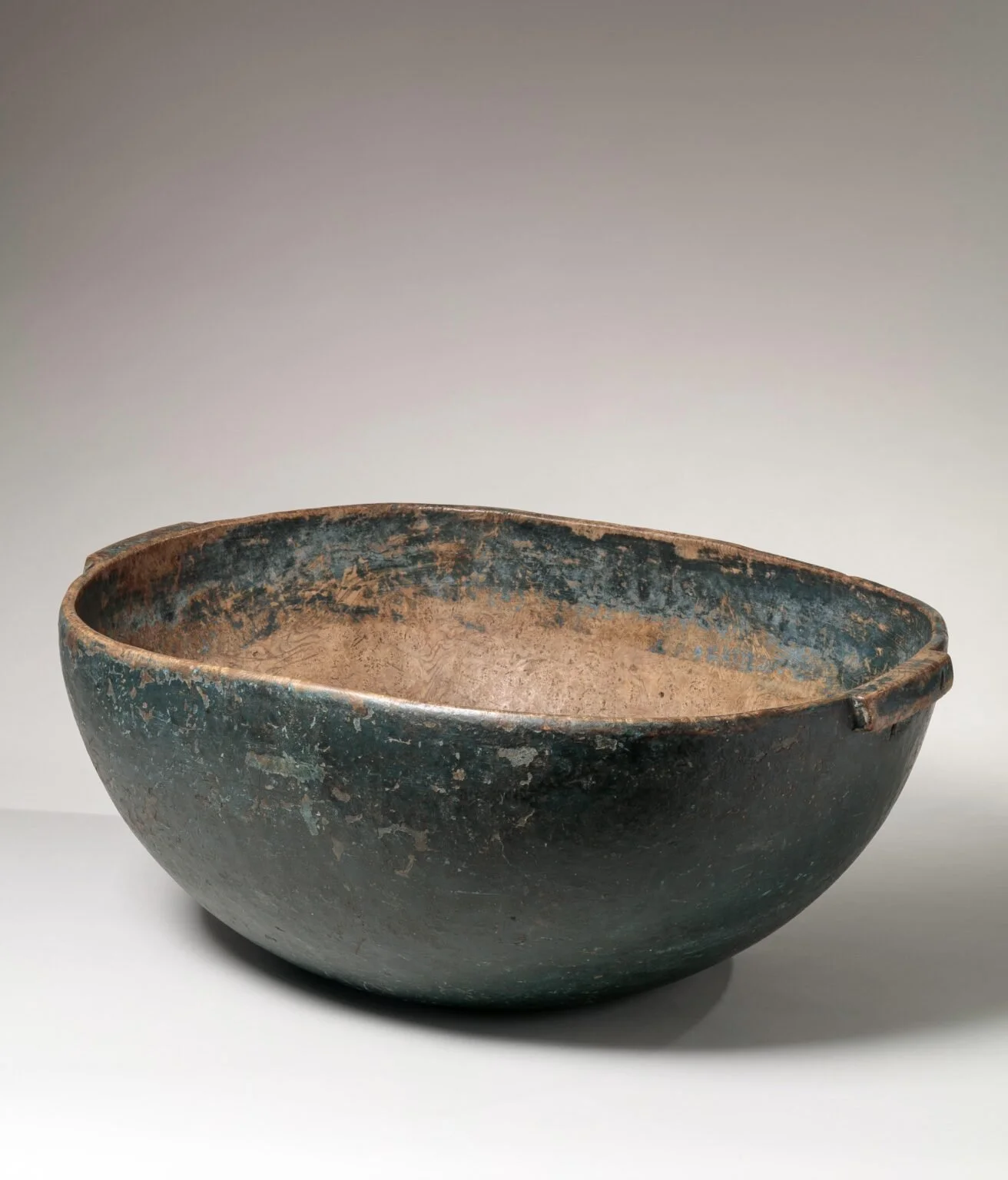
Probably Eastern Great Lakes Region, circa 1780–1820
Carved ash burl with worn Prussian blue painted surface.
9 ½ x 24 x 15 ¾ inches
This exceptional oval burl bowl is notable for its grand scale, thinly hewn walls, and rare survival of an early blue-painted surface. The form and workmanship are consistent with bowls attributed to Native makers of the Eastern Woodlands, with its size suggesting use as a communal or feast vessel.
An incised inscription on the underside records its descent through multiple generations of the Lattin family, preserving a continuous line of ownership from the late eighteenth century onward. The bowl’s surface and history together contribute to its strong presence and significance within American folk art.
Provenance:
By descent in the Lattin family, New York State, from the late 18th century to 2016
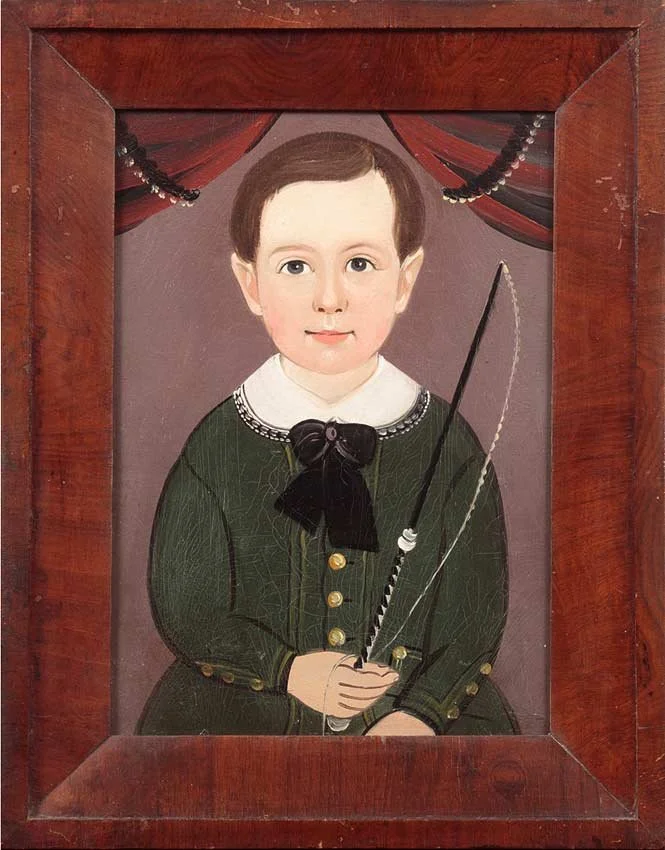
Sturtevant J. Hamblin (1817–1884)
New England, circa 1845
Oil on artist’s board, in original mahogany veneered frame.
14 x 10 inches
This engaging portrait depicts a young boy dressed in a vivid green jacket, holding a whip, rendered with the clarity and directness characteristic of Hamblin’s work. The composition is simple yet effective, with careful attention to costume and expression lending the figure a strong sense of individuality.
Provenance:
Northeast Auctions, Manchester, New Hampshire, 1993;
Wayne Pratt, Woodbury, Connecticut;
Collection of Mr. and Mrs. Robert V. Matthews, Washington, Connecticut
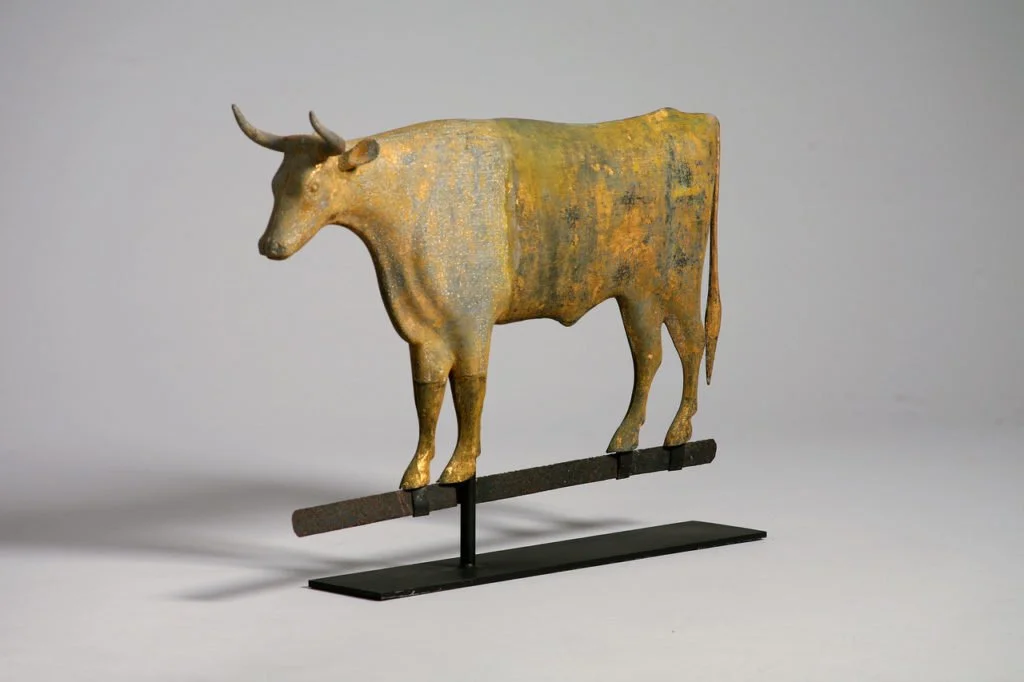
Jonathan Howard & Co., West Bridgewater, Massachusetts, circa 1860
Moulded copper and cast zinc with original gilded surface.
Length 28 inches
This finely modelled steer weathervane reflects the distinctive style associated with Jonathan Howard & Co., among the most respected makers of nineteenth-century American weathervanes. The form is both sculptural and refined, with a strong sense of presence.
The surface retains its original gilding, lending the piece a particularly rich and desirable appearance. Examples of this quality and preservation are increasingly scarce.
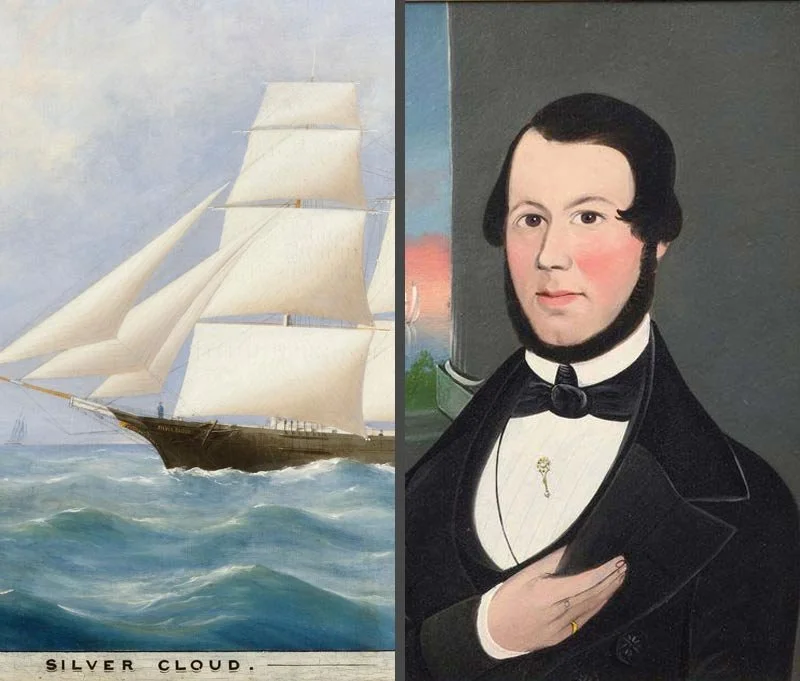
American, circa 1853
Ship Portrait — Silver Cloud
Oil on canvas, in original walnut and gilt frame.
25 x 30 inches
Portrait of Captain Thomas W. Lewis
Attributed to Sturtevant J. Hamblin (1817–1884)
Oil on artist board, in original walnut and gilt frame.
18 x 13 inches
This compelling pair unites a portrait of the merchant bark Silver Cloud with a likeness of her captain, Thomas W. Lewis. The ship portrait, inscribed with the vessel’s name and captain, documents a working vessel active in international trade before later entering whaling service.
The accompanying portrait, attributed to Sturtevant J. Hamblin, provides a rare personal counterpart, linking the vessel directly to its commander. Together, the paintings form a cohesive and historically resonant grouping within American maritime folk art.
Provenance:
By descent in the family of Captain Thomas W. Lewis
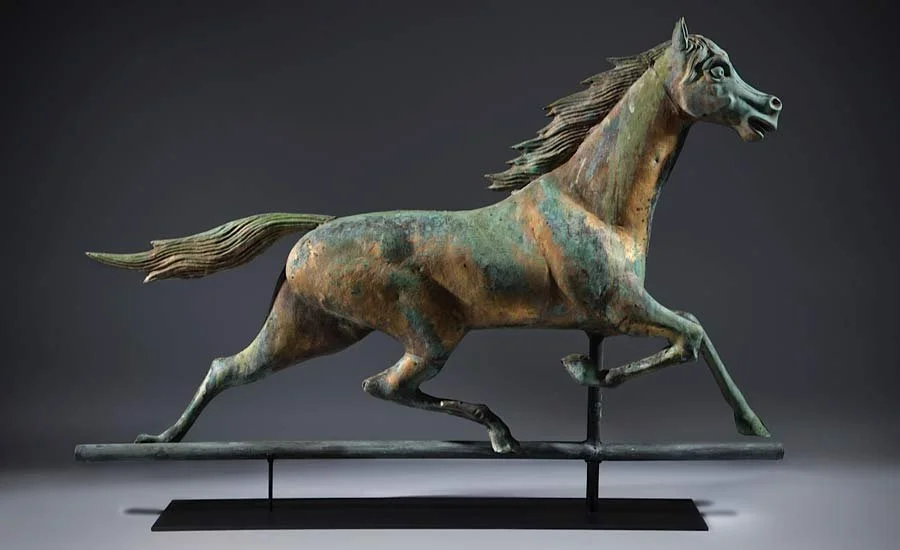
New York, late 19th century
Weathervane:
Moulded copper and cast brass with original gilt and verdigris surface; early in-use solder repairs and minor wear consistent with age.
31 x 44 x 5 inches
Map:
Ink and watercolour on paper, depicting the J. L. Mott Ironworks, Mott Haven, New York.
14 x 16 ¾ inches
This rare pairing brings together a monumental running horse weathervane and a period watercolour map of the J. L. Mott Ironworks, one of the leading American producers of ornamental metalwork in the nineteenth century. The weathervane corresponds to a documented Mott model illustrated in the firm’s 1892 catalogue, representing the celebrated trotter “Nelson.”
The accompanying map offers a unique visual record of the factory responsible for such works, creating a compelling link between object and origin.
Provenance:
Weathervane: Midwestern private collection
Map: Collection of Allan L. Daniel
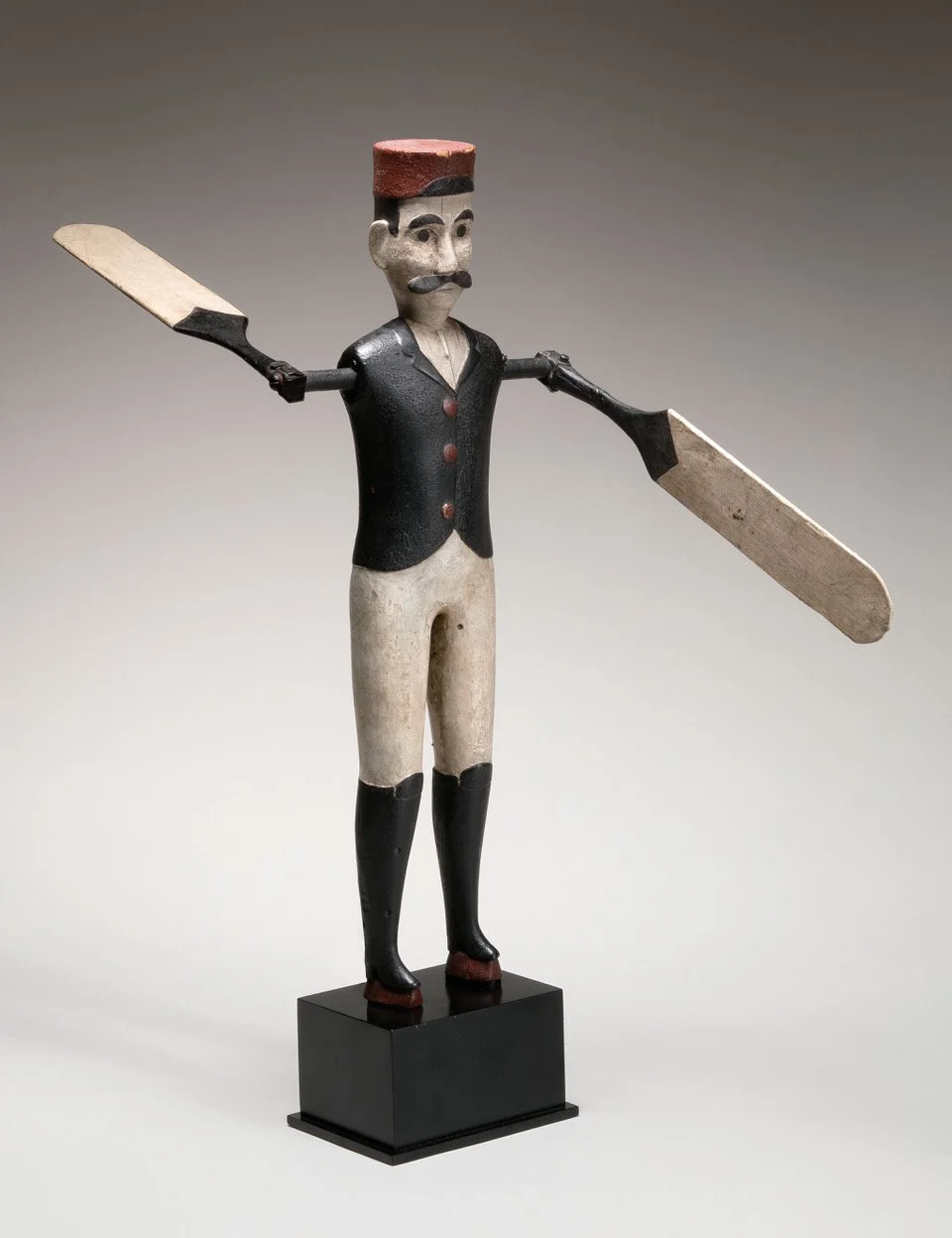
American, circa 1860–1880
Carved white pine with original painted decoration.
Height 21 ¾ inches
This finely carved whirligig depicts a train conductor with a distinctive handlebar moustache, detailed uniform, and articulated paddles, all retaining their original surfaces. The figure’s expressive carving and strong presence place it among the more compelling examples of American kinetic folk art.
Remarkably well preserved, the work combines sculptural detail with functional design, reflecting both craftsmanship and ingenuity.
Provenance:
Betty Sterling;
George E. Schoellkopf Gallery;
David A. Schorsch;
Barry Cohen;
Collection of Dr. and Mrs. Ed Hoffman;
Important Midwest private collection;
Austin T. Miller American Antiques
Exhibited & Published:
Exhibited and illustrated in notable collections and publications on American folk art
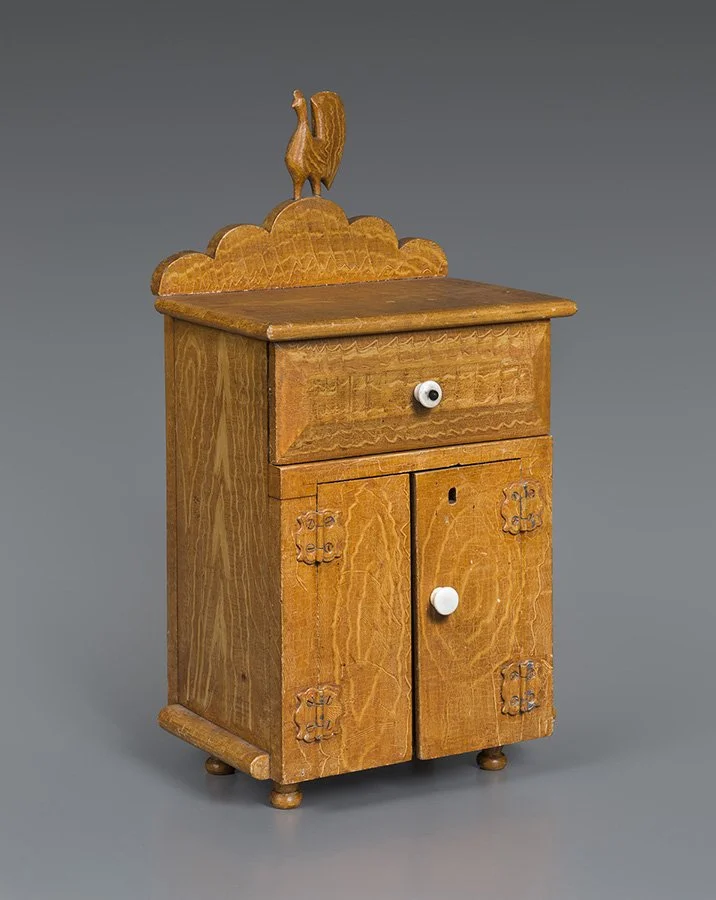
Probably Lancaster County, Pennsylvania, circa 1875
Poplar with original yellow comb-grained decoration and hardware.
17 ¼ x 8 x 6 ½ inches
This finely made miniature cupboard, likely produced for a child, features a carved rooster ornament at the backsplash and retains its original comb-grained surface and hardware. The bold yellow decoration and form are characteristic of southeastern Pennsylvania furniture of the period.
The combination of scale, surface, and whimsical carved detail makes this a particularly appealing and uncommon example within Pennsylvania German folk art.
Provenance:
Found in Lancaster County, Pennsylvania;
Collection of Richard Flanders Smith;
Christie’s, 1995;
Private collection, 1995–2016
Exhibited:
The Allentown Art Museum;
The Historical Society of Berks County
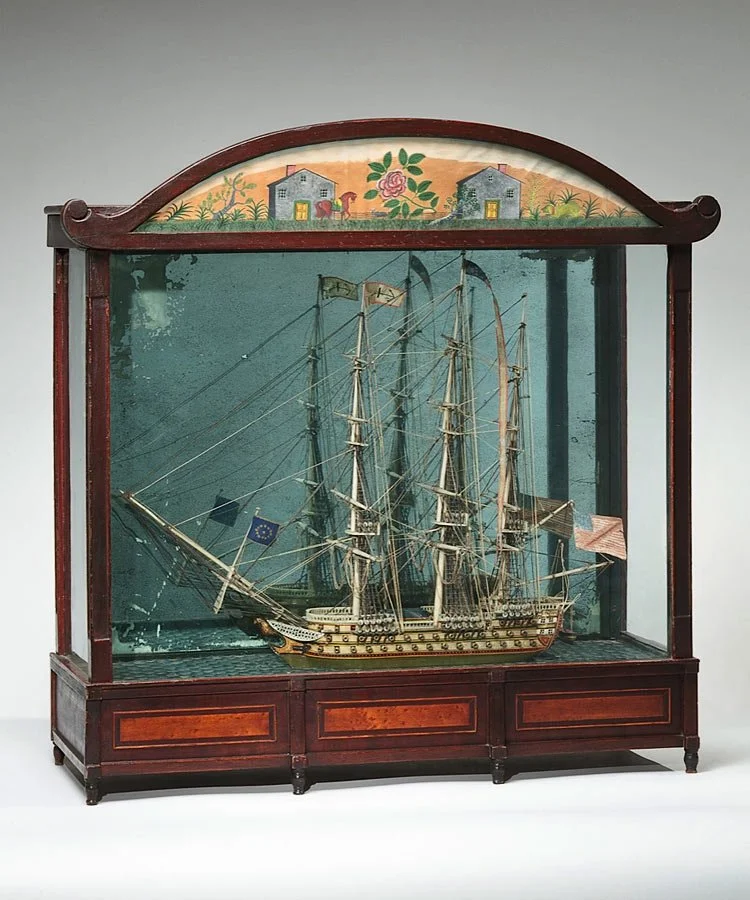
Pennsylvania, circa 1810–1820
Ship model in bone, wood, brass, paint, and string, set against a watercolour backdrop. Housed within a cabinet of cherry and bird’s-eye maple veneer with white pine secondary wood, retaining original mirror plate, glass, and finish.
Cabinet: 21 ¼ x 20 x 7 inches
This finely constructed ship model is presented within its original display cabinet, creating a unified object that combines craftsmanship and presentation. The detailed model, set against a painted backdrop and mirrored interior, reflects an early nineteenth-century interest in both maritime subjects and decorative display.
Provenance:
Israel Sack, Inc., New York;
Collection of Ralph O. Esmerian
Published:
American Antiques from the Israel Sack Collection, Vol. IX, p. 2530
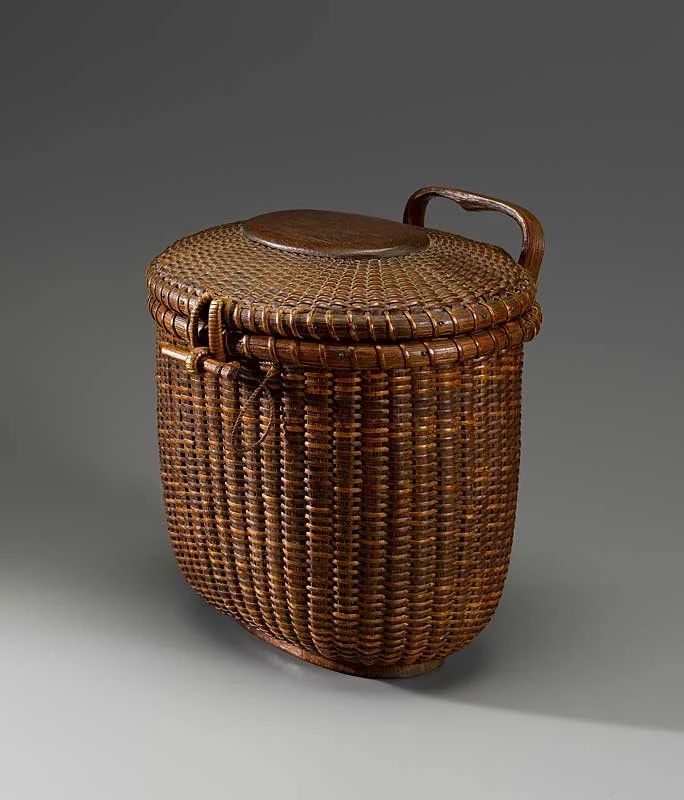
Nantucket, Massachusetts, circa 1945
Oak, rattan, leather, and string with original resin-based finish.
8 ½ x 8 ½ x 8 inches
This rare hanging wall basket is attributed to José Formoso Reyes, one of the most important figures in twentieth-century Nantucket basketry. Combining traditional construction with a distinctive, functional form, the piece reflects both continuity and innovation within the craft.
Examples of this type are exceptionally scarce, with only a small number of related forms known. Reyes is widely recognized for sustaining and advancing Nantucket basketmaking in the mid-twentieth century, and works of this nature are particularly sought after.
Provenance:
The personal collection of Marguerite and Arthur Riordan, Stonington, Connecticut
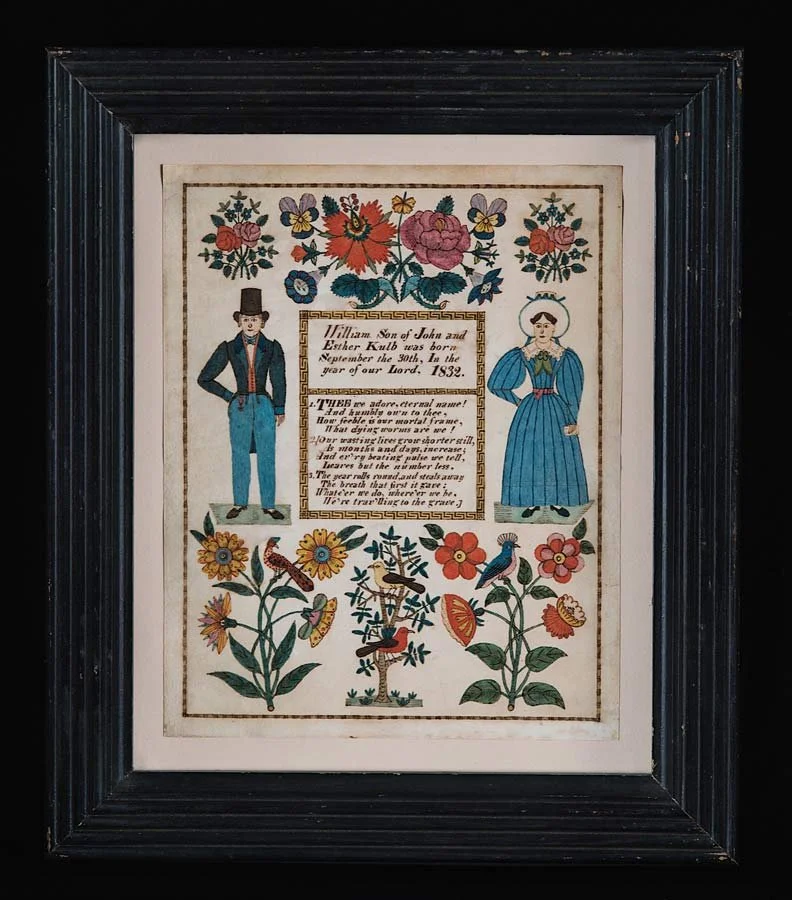
Union County, Pennsylvania, 1832
Watercolour and ink on paper, in a period painted frame.
9 ⅞ x 7 ⅞ inches
This finely executed fraktur by John Zinck represents a distinctive and recognizable type, featuring a formally dressed couple flanking an inscribed text within a structured border. The composition is enriched with carefully rendered figures, birds, and floral elements, all executed with precision and control.
The present example stands out for its vibrant palette—particularly its strong reds and blues—and ranks among the finest of its kind. It was made for William Kulb, born September 30, 1832, in Union County, Pennsylvania.
Provenance:
Hattie K. Brunner;
Edgar William and Bernice Chrysler Garbisch Collection;
Sotheby Parke Bernet, 1974;
Ralph O. Esmerian Collection;
Sotheby’s, New York, 2014
Exhibited & Published:
Included in major exhibitions and literature on American fraktur and folk art
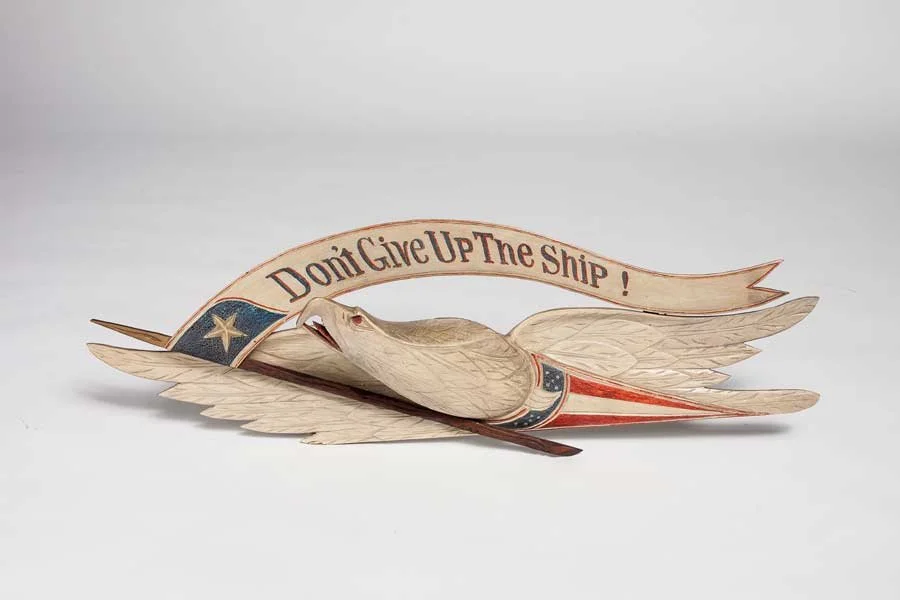
John Haley Bellamy (1836–1914)
Circa 1880
Carved and polychrome-painted white pine.
26 ½ inches long; 8 inches high; 6 inches deep
This finely carved eagle, bearing the patriotic motto “Don’t Give Up the Ship,” is a strong example of Bellamy’s work, combining crisp carving with a lively, graphic presence. The composition reflects the bold yet refined style for which he is widely recognized.
Bellamy remains one of the foremost carvers of American eagles, and examples featuring banners are particularly sought after within his body of work.
Reference:
Yvonne Brault Smith, John Haley Bellamy: Carver of Eagles (1982), with a closely related example illustrated
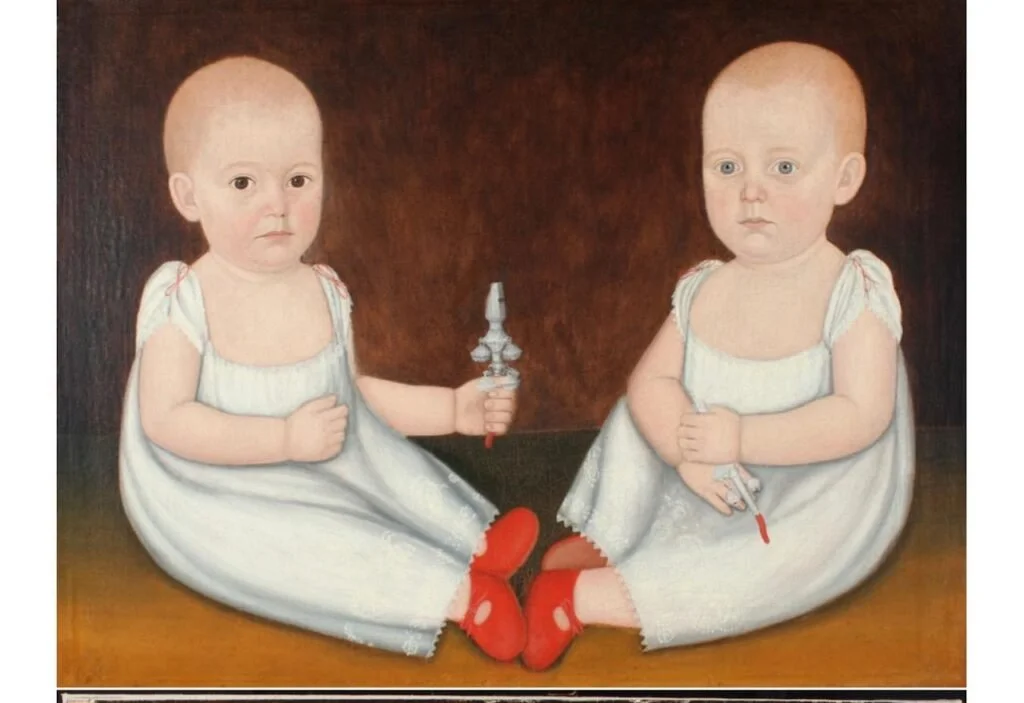
Josiah Coffin Dow and Richard Weare Dow
Salem, Massachusetts, circa 1810
Oil on canvas; formerly mounted on a smaller stretcher; relined with areas of inpainting.
22 x 29 inches
This rare double portrait by John Brewster, Jr. depicts twin brothers Josiah Coffin Dow and Richard Weare Dow as infants, and can be closely dated to circa 1810 based on their age. The composition reflects Brewster’s characteristic clarity and sensitivity, capturing both likeness and presence with remarkable economy.
The painting descended directly through the Dow family before entering prominent private collections, and relates to Brewster’s documented activity in Salem during this period. Works of this type—particularly double portraits—are uncommon within his oeuvre.
Provenance:
By descent in the Dow family;
Doyle Galleries, New York, 1981;
Collection of Peter and Barbara Goodman;
Christie’s, New York, 2022
Exhibited & Published:
Included in major exhibitions and literature on the work of John Brewster, Jr.
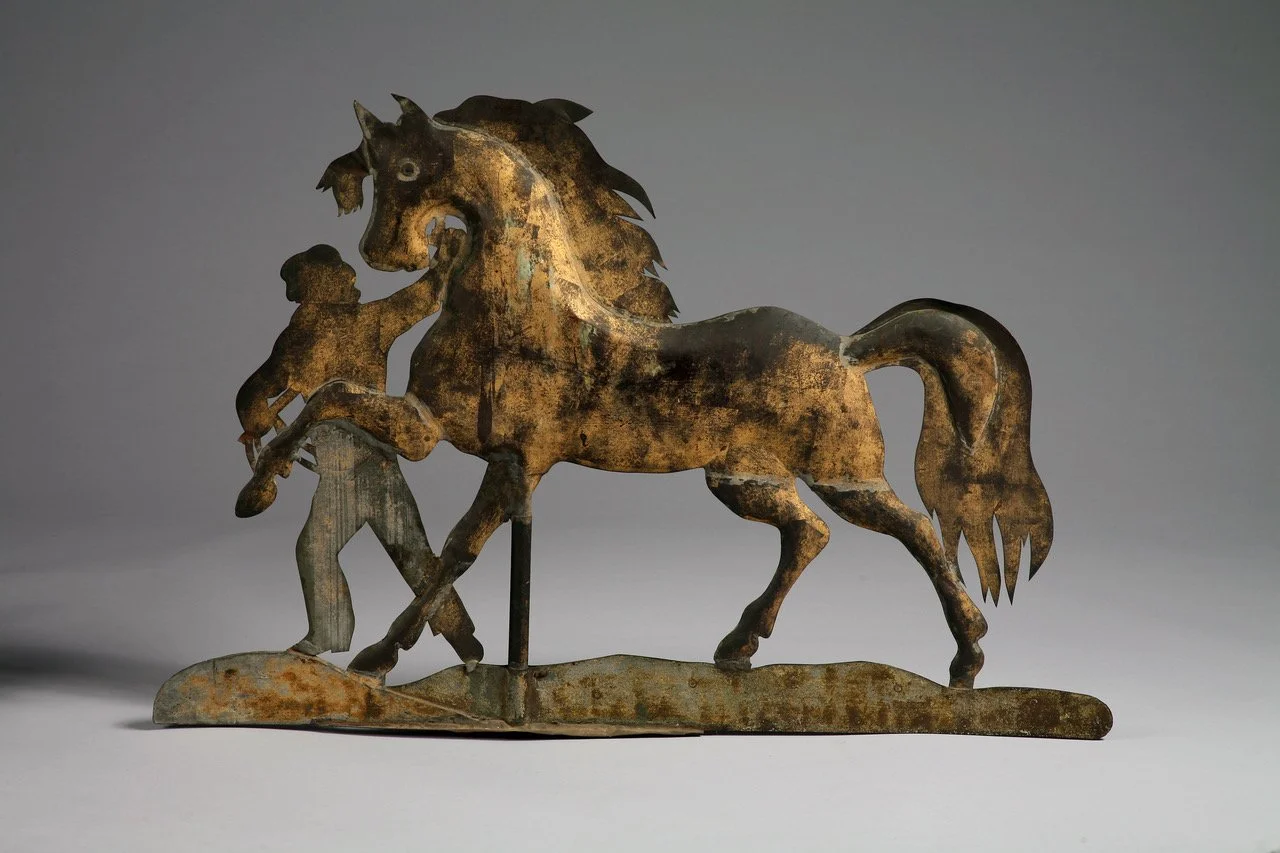
American, 19th century
Length 26 inches
This rare horse and groom weathervane is one of only a small number of known examples. The composition, combining rider and mount in a single unified form, is both visually engaging and uncommon within American weathervane production.
Among the known examples, this stands as a particularly strong and well-preserved representation of the type.
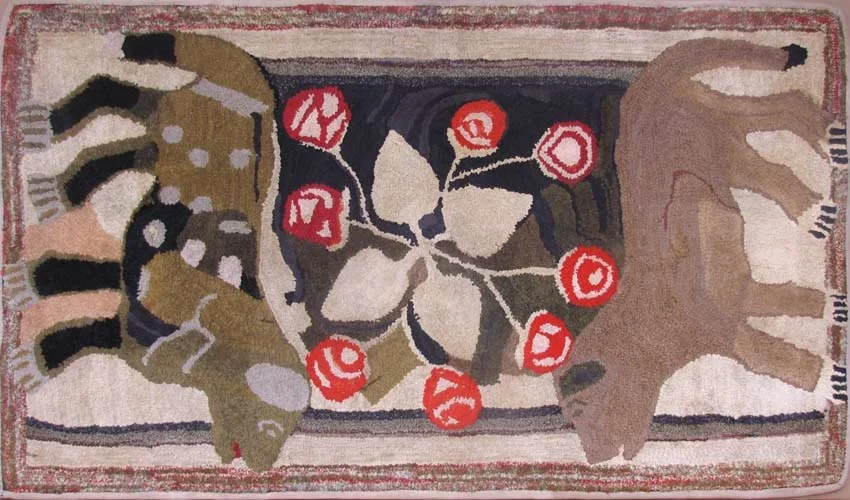
New England, circa 1880
Wool fabrics hooked on burlap.
30 x 55 inches
This charming hooked rug features two stylized dogs positioned at either end, framing an abstract floral cluster at the centre. The composition balances symmetry with playful character, while the bold forms and colour choices reflect the inventive spirit of late nineteenth-century New England textile folk art.
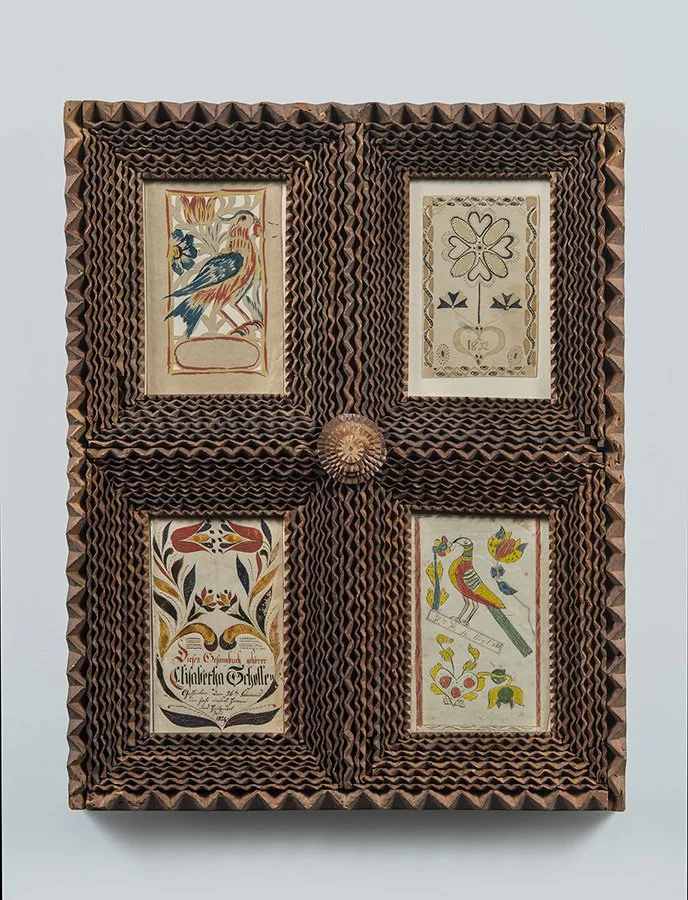
Pennsylvania, bookplates circa 1820–1836; frame circa 1860–1880
Watercolour and ink on paper, including examples attributed to Wilhelm Antonius Faber and others, featuring birds, florals, and devotional inscriptions. Housed within a carved tramp art frame of layered, chip-carved wood with a dark original surface.
Frame: 20 x 16 inches
This assembled group of four fraktur bookplates brings together finely executed examples of Pennsylvania German folk art, each reflecting the vibrant colour, symbolism, and personal expression characteristic of the tradition. The integration of these works within a period tramp art frame creates a compelling dialogue between two distinct but complementary forms of American folk craftsmanship.
Provenance:
Joe Kindig, Jr., York, Pennsylvania;
Collection of H. William Koch;
Pook & Pook, 1999;
Collection of Virginia Ramsey-Pope Cave;
Northeast Auctions, 2000;
Private collection, 2000–2015
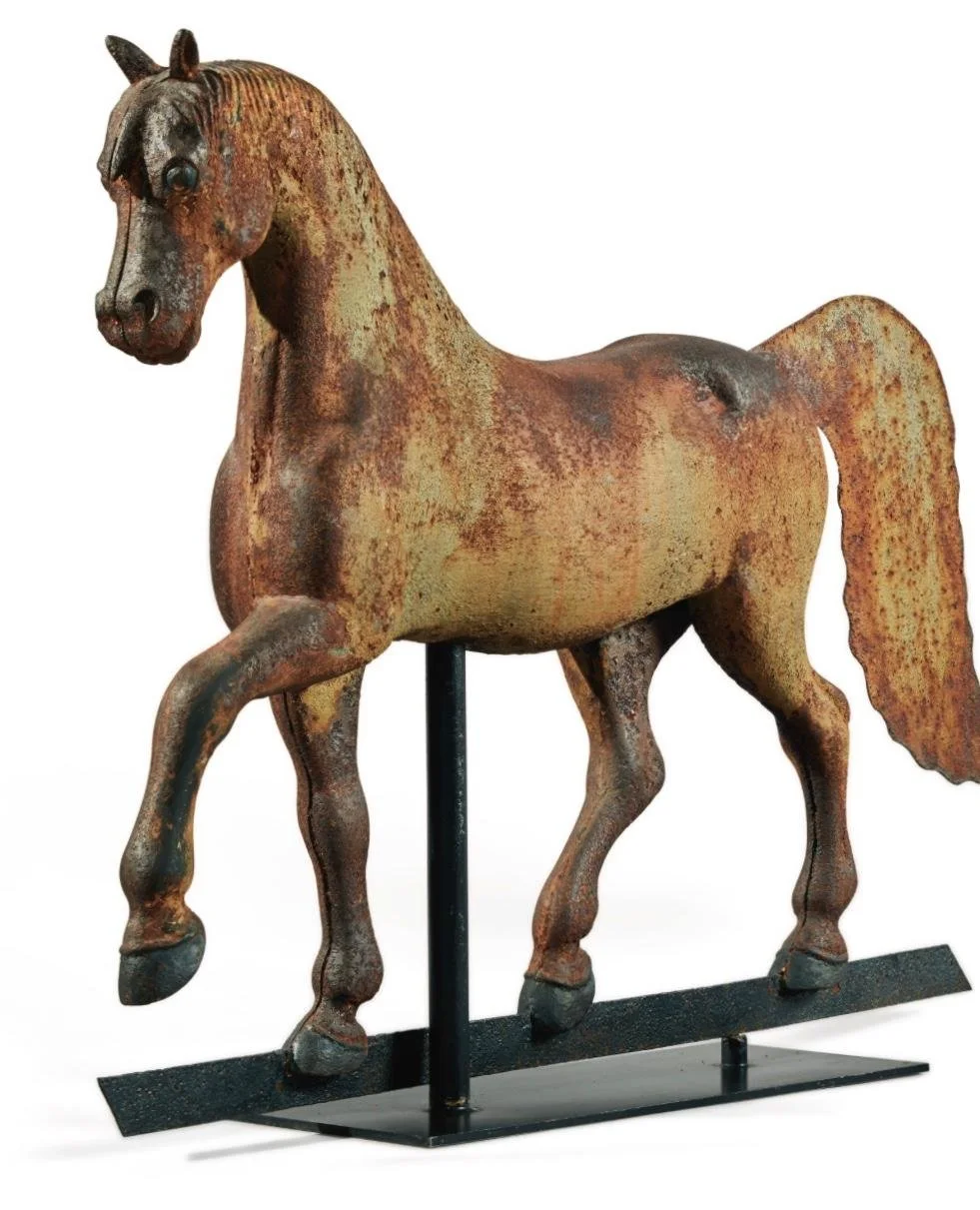
Possibly New Hampshire, circa 1860–1880
Cast and sheet iron with original paint.
27 ½ x 37 ½ x 5 ½ inches
This finely modelled horse weathervane represents the strongest known example from a small group attributed to an unidentified maker, distinguished by their fully three-dimensional cast bodies with sheet metal tails. The form is both sculptural and restrained, with a distinctive construction that sets the group apart.
Once loosely associated with a “Rochester Iron Works” in New Hampshire, recent research has found no evidence to support that attribution, leaving the maker unknown while further emphasizing the rarity of the group.
Provenance:
Found in Vermont;
Collection of Gary and Melissa Lipton;
Collection of Marna Anderson;
Stephen Score, Boston;
Collection of Joyce Linde; Sotheby’s, New York, 2020
Published:
Illustrated in major recent works on American weathervanes and folk art
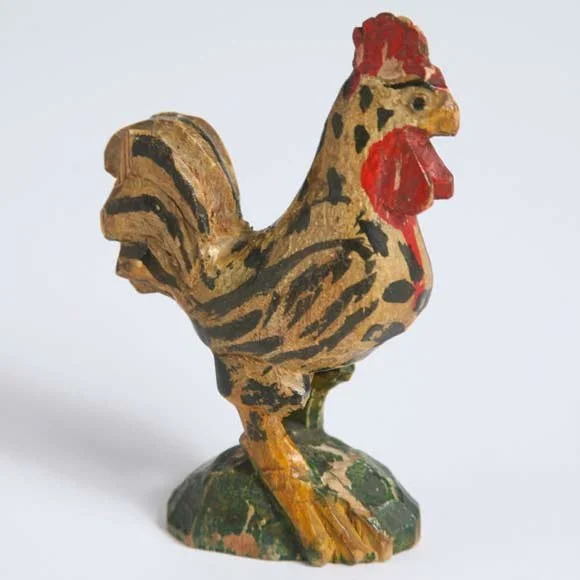
Wilhelm Schimmel (1817–1890), Carlisle County, Pennsylvania, circa 1880
Carved, gessoed, and polychrome-painted white pine.
4 ½ x 1 ½ x 3 ¼ inches
This finely carved rooster exemplifies Schimmel’s distinctive approach, combining expressive form with lively polychrome surface. Despite its small scale, the work conveys a strong sense of movement and character through confident carving and bold colour.
Schimmel is widely regarded as one of the most important American folk sculptors of the nineteenth century, and his carvings—often produced during a transient life in central Pennsylvania—remain among the most recognizable in the field.
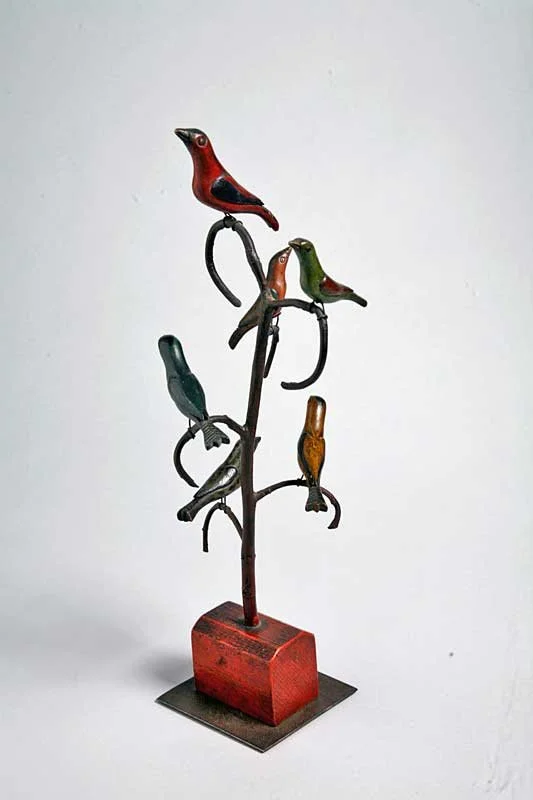
Attributed to Schtockschnitzler Simmons (active 1885–1910)
Berks County, Pennsylvania, circa 1900
Possibly sassafras and dogwood with original painted decoration.
Height 15 inches
This charming bird tree is attributed to the itinerant carver known as Schtockschnitzler Simmons, a German immigrant active in southeastern Pennsylvania. His distinctive constructions—formed from shaped saplings and adorned with brightly painted birds—stand among the most recognizable expressions of the region’s folk carving tradition.
Examples of Simmons’ work are held in major museum collections, and his bird trees remain particularly sought after for their inventive form and lively presence.
Provenance:
American Folk Art Gallery, New York;
Collection of Mrs. Olive Beaupre Miller;
Private collection
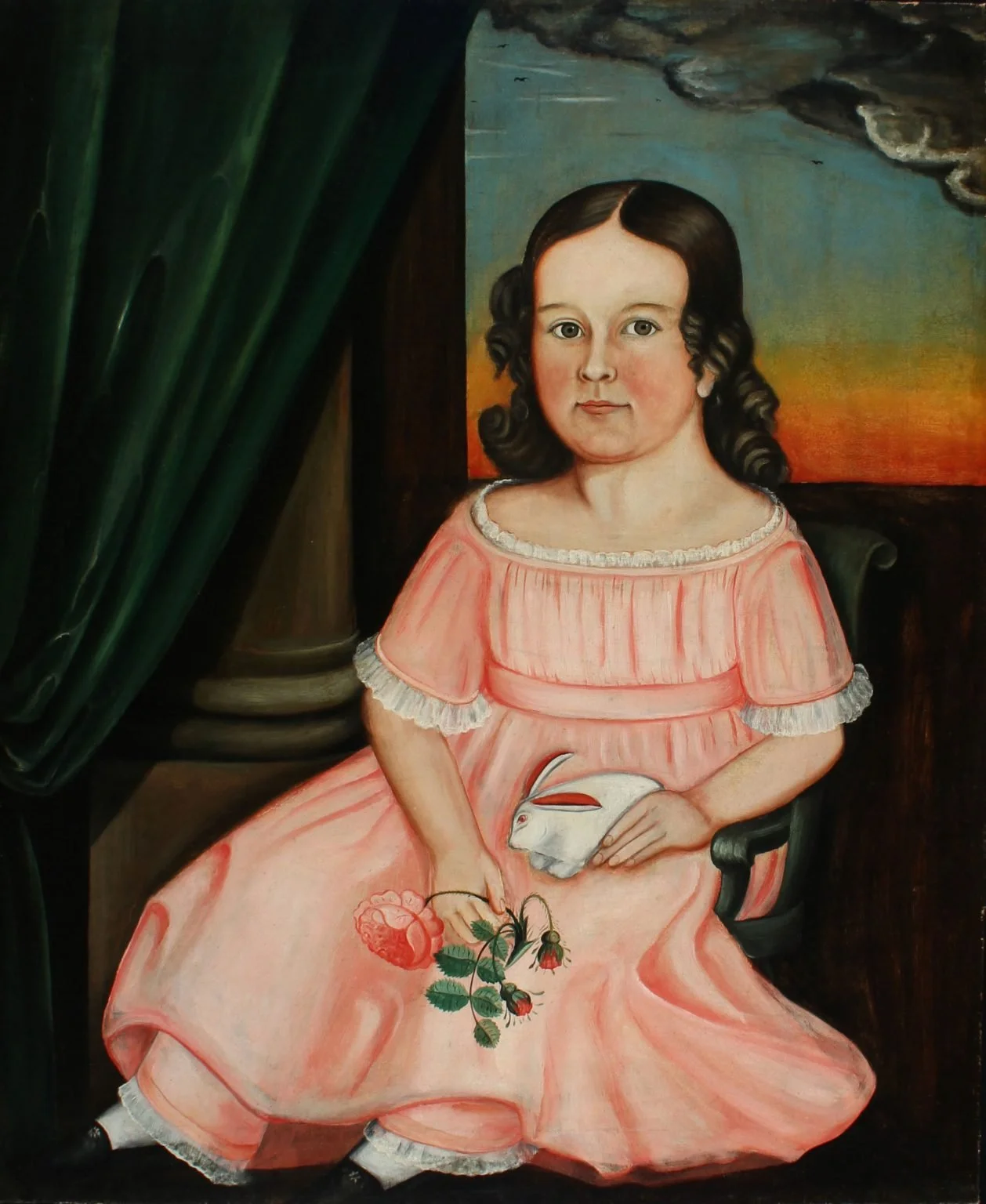
Concord, Ohio, 1840
Oil on canvas.
34 x 28 inches
This portrait by Ohio painter David Bulle presents Mary Gahagan with a directness and clarity characteristic of mid-nineteenth-century American folk portraiture. The composition is straightforward yet assured, with careful attention to facial expression and dress lending the work a quiet dignity.
Bulle’s portraits are valued for their honest, unembellished approach, offering a compelling record of regional life and artistic practice in early Ohio.
Published:
Jane Sikes Hageman, Ohio Pioneer Artists: A Pictorial Review (Cincinnati, 1993), p. 35, plate V
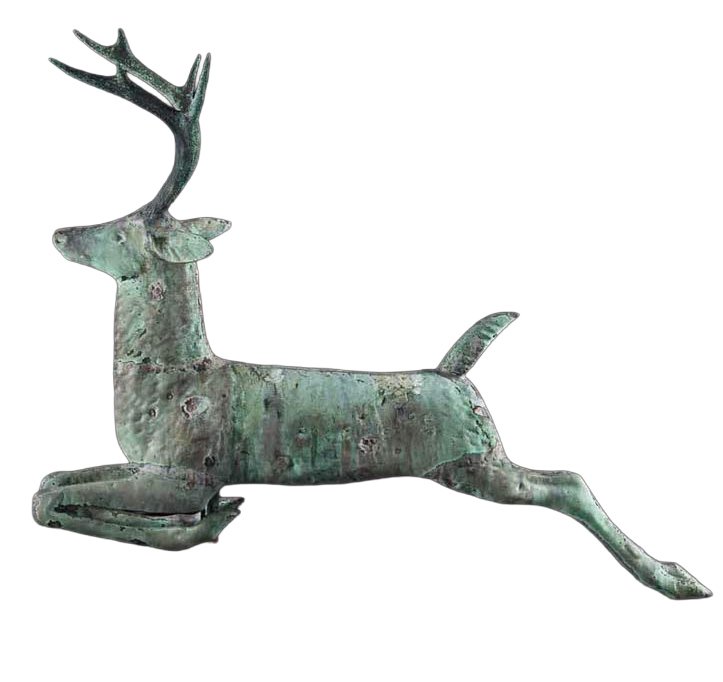
Cushing & White, Waltham, Massachusetts, circa 1890
Moulded copper and cast zinc with exceptional original verdigris surface.
29 x 30 x 9 inches
This dynamic leaping stag exemplifies the refined modelling and naturalistic detail associated with Cushing & White, one of the leading American weathervane makers of the late nineteenth century. The figure’s extended form and animated posture convey a strong sense of motion, while the surface has developed a particularly rich and appealing patina.
Provenance:
Midwestern private collection
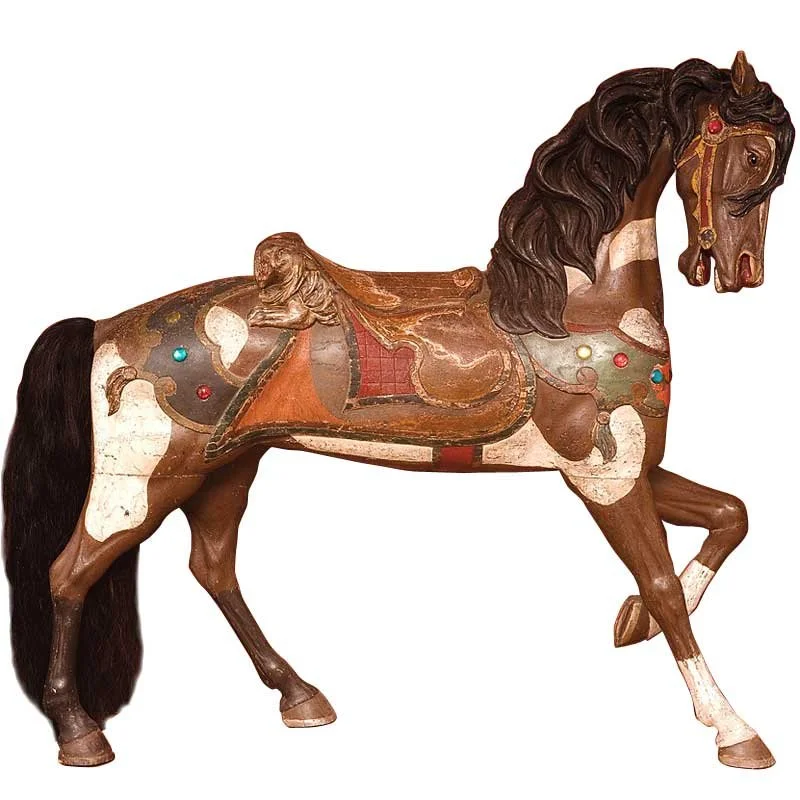
Coney Island, New York, circa 1890
Carved pine with original and old park paint.
57 x 13 x 62 inches
This carousel horse was produced by Charles I. D. Looff, one of the leading figures in the development of American amusement carving. Associated with Coney Island, Looff established a distinctive style marked by energetic carving, bold ornament, and strong visual presence.
The present example reflects that tradition, retaining its layered park paint and conveying the sense of movement and vitality that defines Looff’s work at its best.
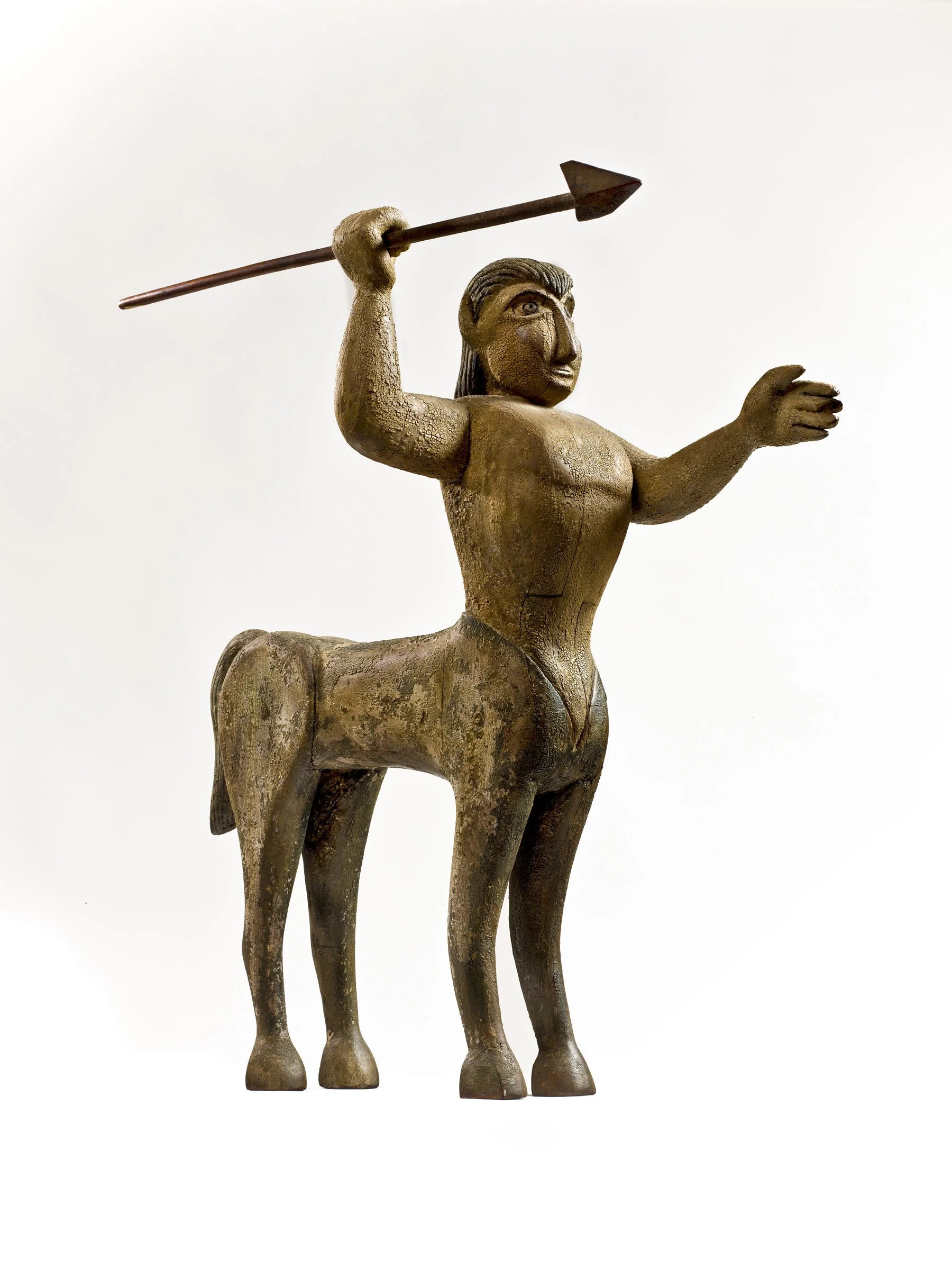
Attributed to “Mr. Dines,” Utica, New York, circa 1860
Carved poplar with original painted decoration.
22 ¼ x 9 ½ x 24 ½ inches
This striking centaur figure is attributed to the elusive “Mr. Dines,” an unidentified maker associated with a small and distinctive body of sculptural work. A possible identification is John M. Dines, a wagon maker recorded in Utica in the 1860 Federal Census.
Combining bold form with expressive surface, the figure stands among the most compelling examples of American folk sculpture, with a presence that is both imaginative and deeply rooted in vernacular tradition.
Provenance:
Found in Utica, New York;
Adele Earnest Collection;
The Guennol Collection;
David A. Schorsch and Eileen M. Smiles;
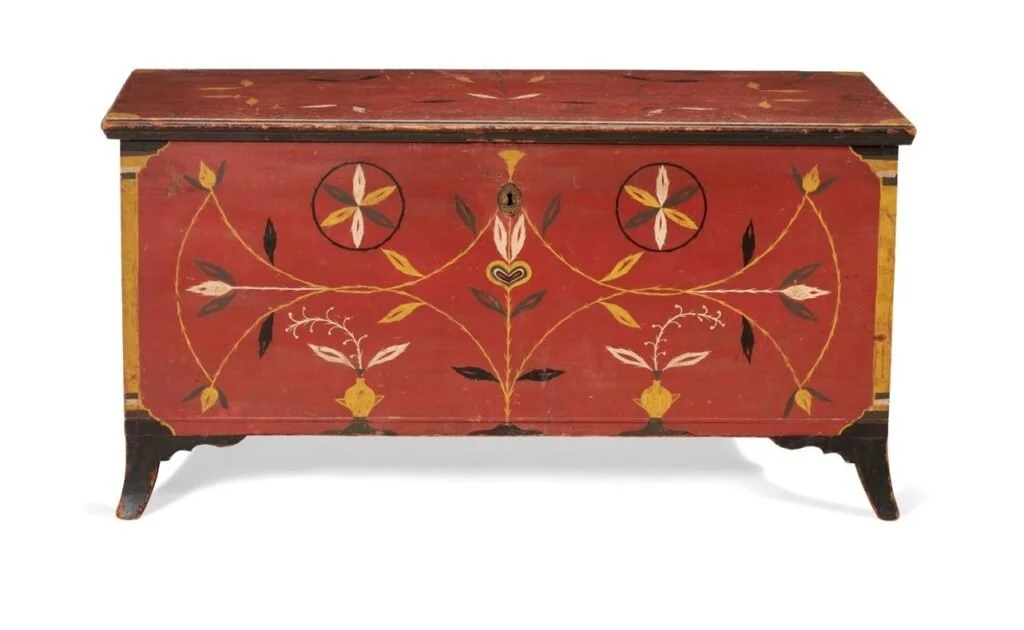
Centre County, Pennsylvania, circa 1810–1820
Poplar with original painted decoration and brass escutcheon.
25 ½ x 49 ¾ x 20 ¾ inches
This exceptional lift-top chest belongs to a rare and highly regarded group sharing a common authorship, distinguished by delicate floral, heart, and pinwheel decoration set against a vibrant red ground, and raised on black-painted French bracket feet. Recent scholarship has firmly placed this group in Centre County, Pennsylvania.
Examples from this small body of work are illustrated in major publications on American painted furniture, underscoring the form’s importance within the tradition.
Provenance:
The Howard and Jean Lipman Collection, Cannondale, Connecticut;
Sotheby’s, New York, 1989;
The Collection of Peter and Barbara Goodman, Rye, New York;
Christie’s, New York, 2022
Exhibited & Published:
Included in major museum exhibitions and literature on American folk art and Pennsylvania German decorated furniture
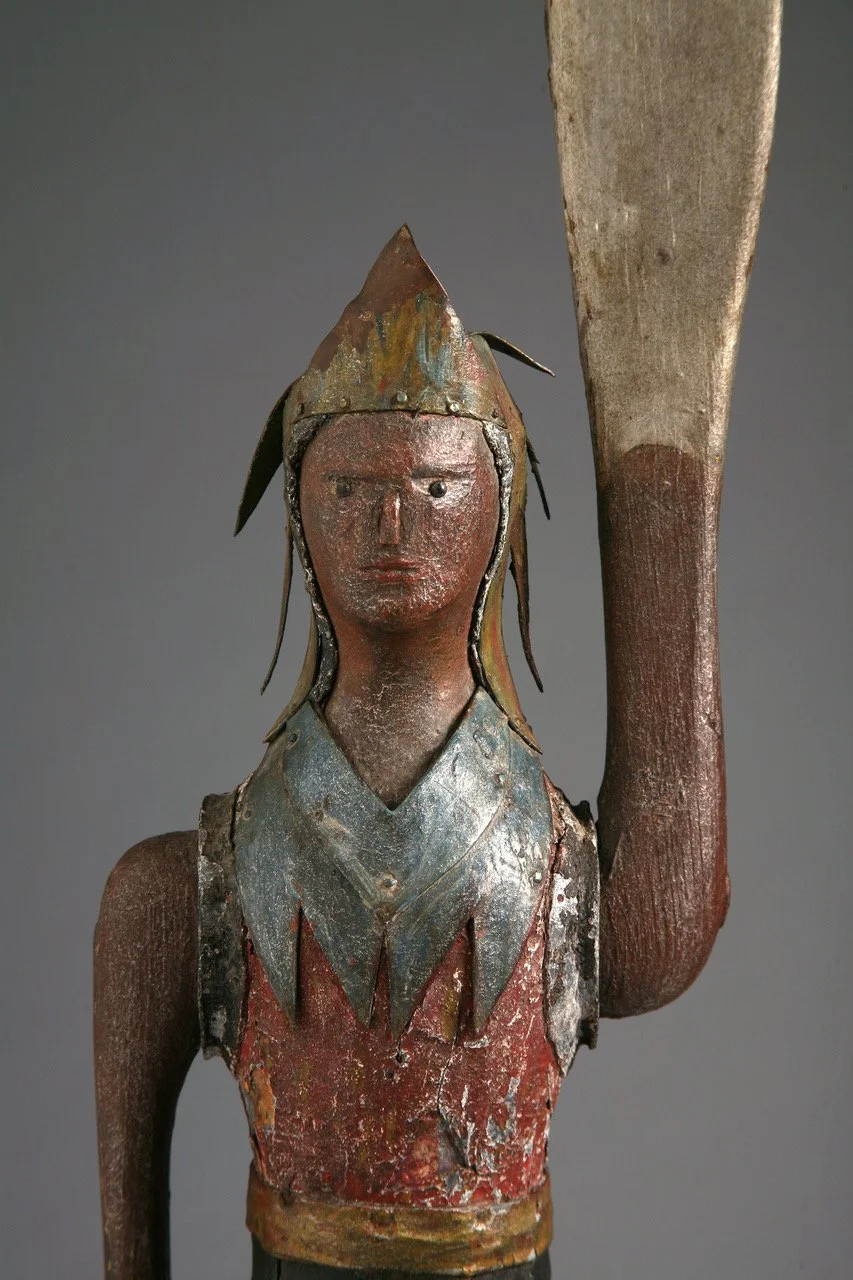
Probably New England, circa 1870
Wood, zinc, and copper with original paint.
Figure height 17 inches; overall height 23 inches
This sculptural whirligig is one of a small and distinctive group attributed to an unidentified but highly accomplished maker. Characterized by its animated form and the use of zinc, copper, and tin for the figure’s ornamented attire and headdress, the work demonstrates both ingenuity and a strong decorative sensibility.
Only a handful of related examples are known, with others held in prominent institutional and private collections. The present example stands as a rare and compelling representation of this maker’s work within the American folk art tradition.
References:
Illustrated and discussed in key publications on American folk sculpture, with comparable examples documented in major collections and past auctions.
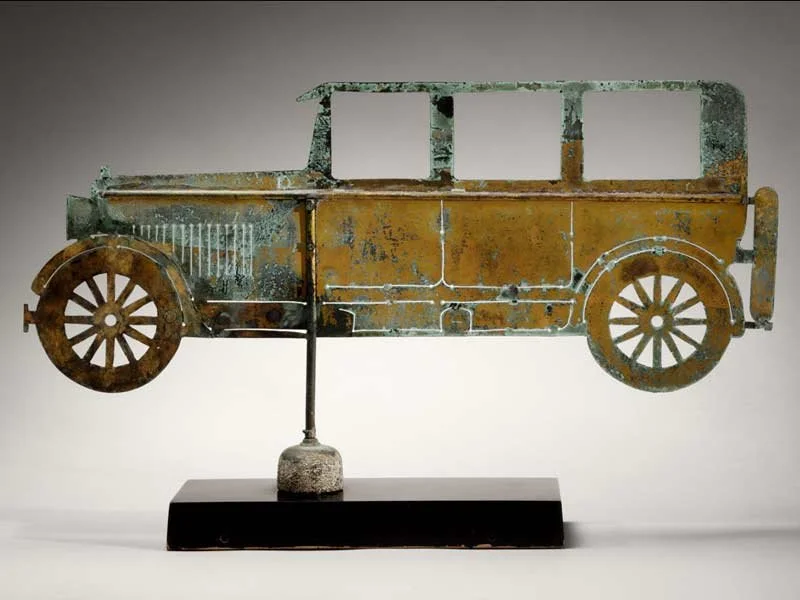
Circa 1920
Silhouetted and pierced sheet copper with original gilt and verdigris surface; mounted on iron rod.
11 x 25 inches
This finely crafted weathervane takes the form of an early motor-car, rendered with precise hand-cut piercing and a strong, graphic silhouette. The design captures both the novelty and optimism of the automotive age, translated into a distinctly folk idiom.
An early in-use iron repair is present at the spindle juncture, along with minor colour reinforcement to a small area of the front wheel; otherwise, the piece remains in a fine state of preservation with a particularly appealing surface.
Published:
Steve Miller, The Art of the Weathervane (Exton, PA, 1984), p. 75
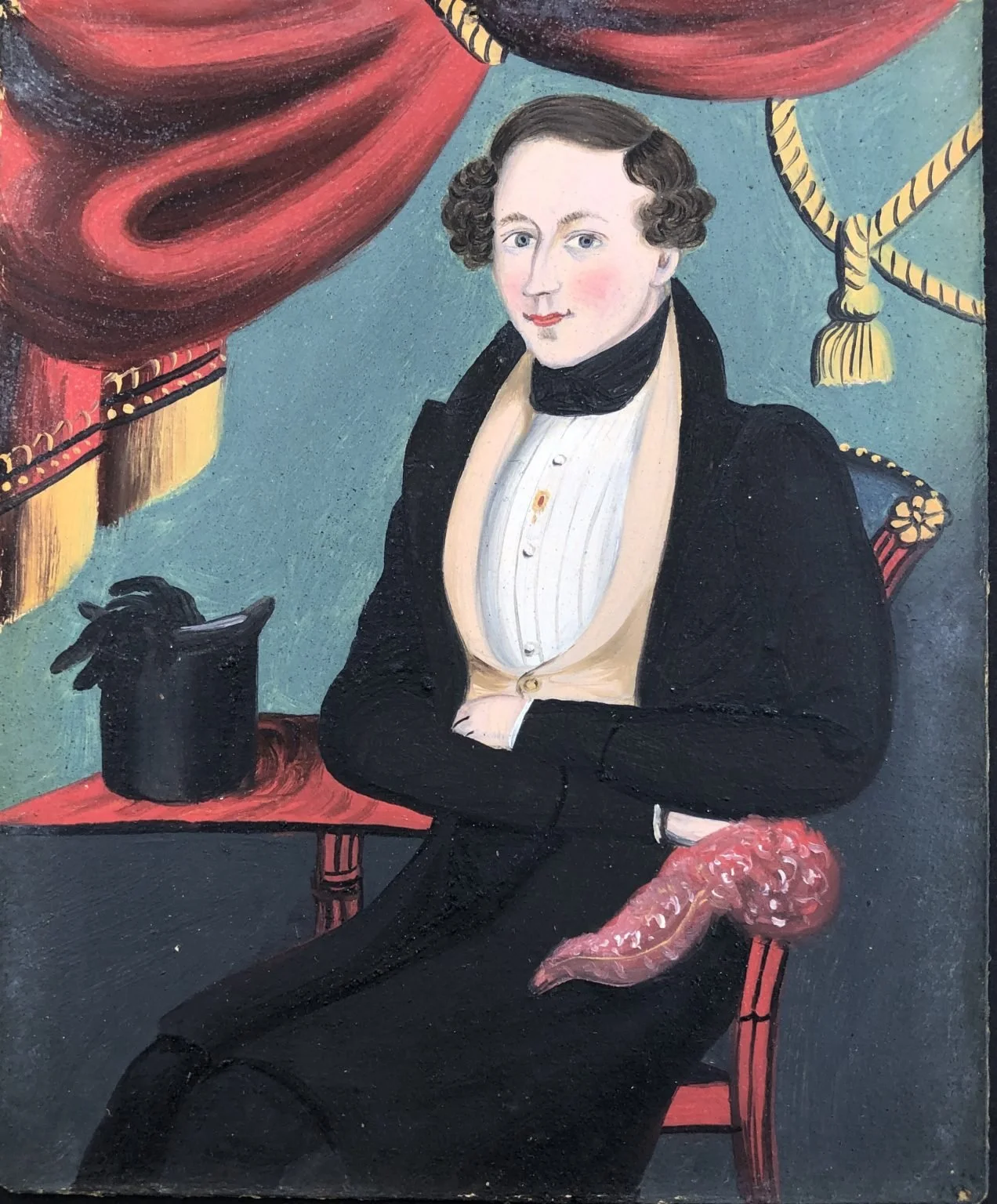
American, circa 1820
Opaque watercolour on paperboard.
6 x 5 ¾ inches
This finely detailed portrait depicts a young gentleman set within a richly appointed Federal interior, rendered with a vibrant palette and careful attention to decorative elements. Despite its small scale, the work carries a strong visual presence and compositional confidence.
The composition relates closely to a known pair of portraits formerly in the Howard and Catherine Feldman Collection and now held at The Huntington Museum of Art, situating this example within a recognizable and important group.
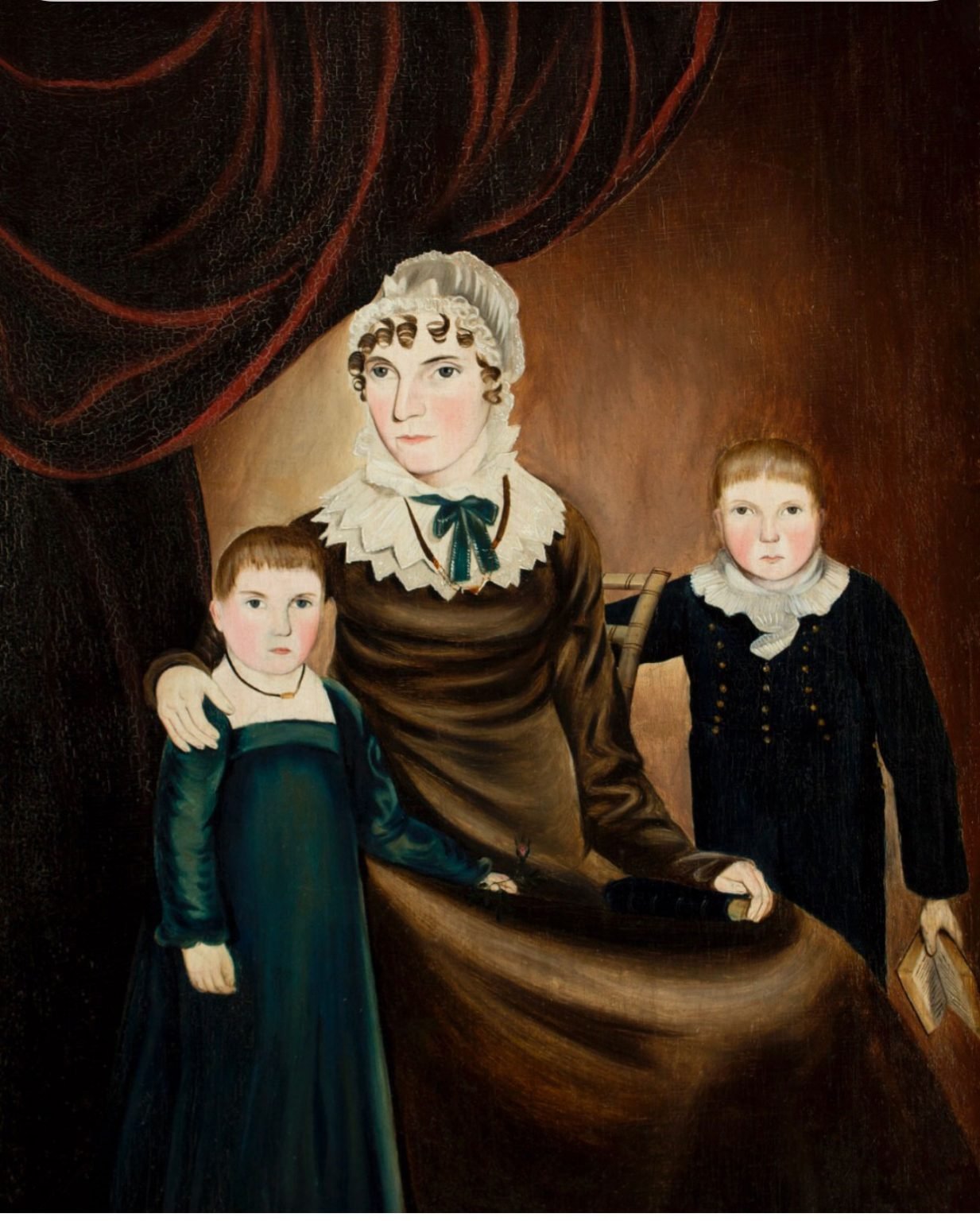
Probably New England, circa 1830
Oil on canvas.
34 x 28 inches
This striking portrait depicts a young woman in a vivid orange dress, accented by a lace bonnet and collar and a distinctive green choker. Her direct gaze and poised presence give the work an immediacy and refinement rarely encountered in naïve portraiture.
The painting takes its name from its discovery at the Ainsworth house in Medina, Ohio. Though the artist remains unidentified, works of this calibre—combining bold colour, compositional confidence, and strong personality—are exceptionally rare within the tradition.
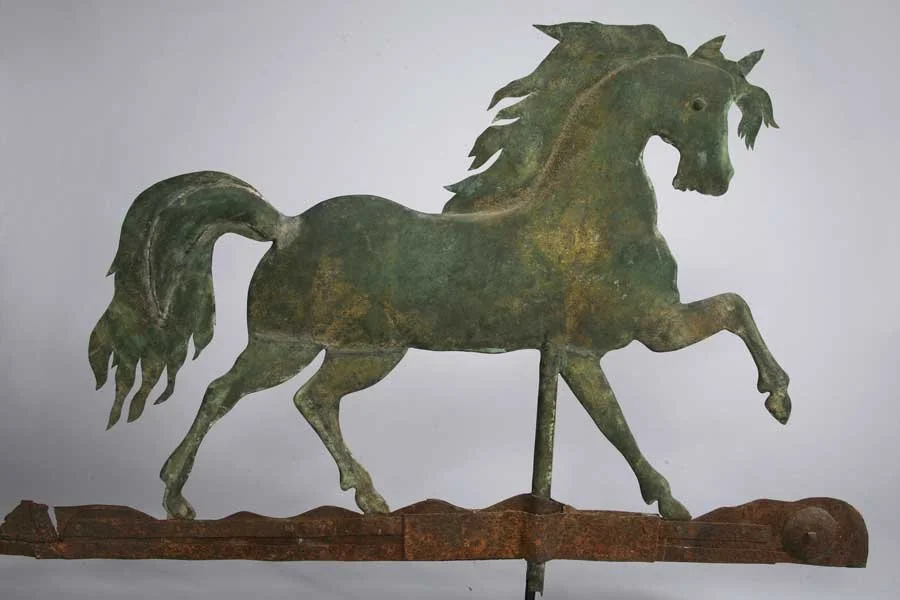
Attributed to A.L. Jewell, Boston, late 19th century
Copper with sheet metal mane, ears, tail, and turf; original verdigris surface with traces of original gilding.
Horse: 26 inches high, 36 inches long; overall length: 51 inches
This prancing horse weathervane features a fully moulded, three-dimensional body set above a sheet-metal strip of turf, with finely formed sheet metal details throughout. Attributed to the Boston maker A.L. Jewell, it exemplifies the bold energy and character for which his equestrian forms are known.
Comparable examples are illustrated in major references on American weathervanes and have appeared in notable collections and auctions.
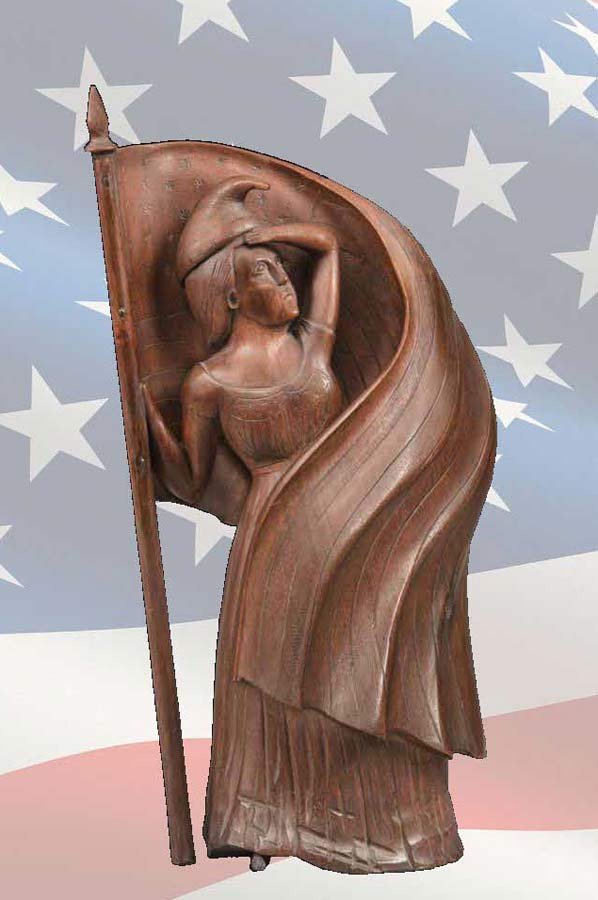
American, circa 1850
Carved walnut with a mellow, old surface.
15 x 7 x 3 inches
Among the rare nineteenth-century carvings of the Goddess of Liberty—typically static in form—this example stands apart for its remarkable sense of movement and animation. The figure’s dynamic presence and flowing treatment of the flag elevate it well beyond the ordinary, marking it as a truly iconic work within American folk art.
Provenance:
The collection of Barbara Johnson
Exhibited:
Liberties with Liberty: The Changing of an American Symbol, The Museum of American Folk Art, New York, 1986; traveled nationally
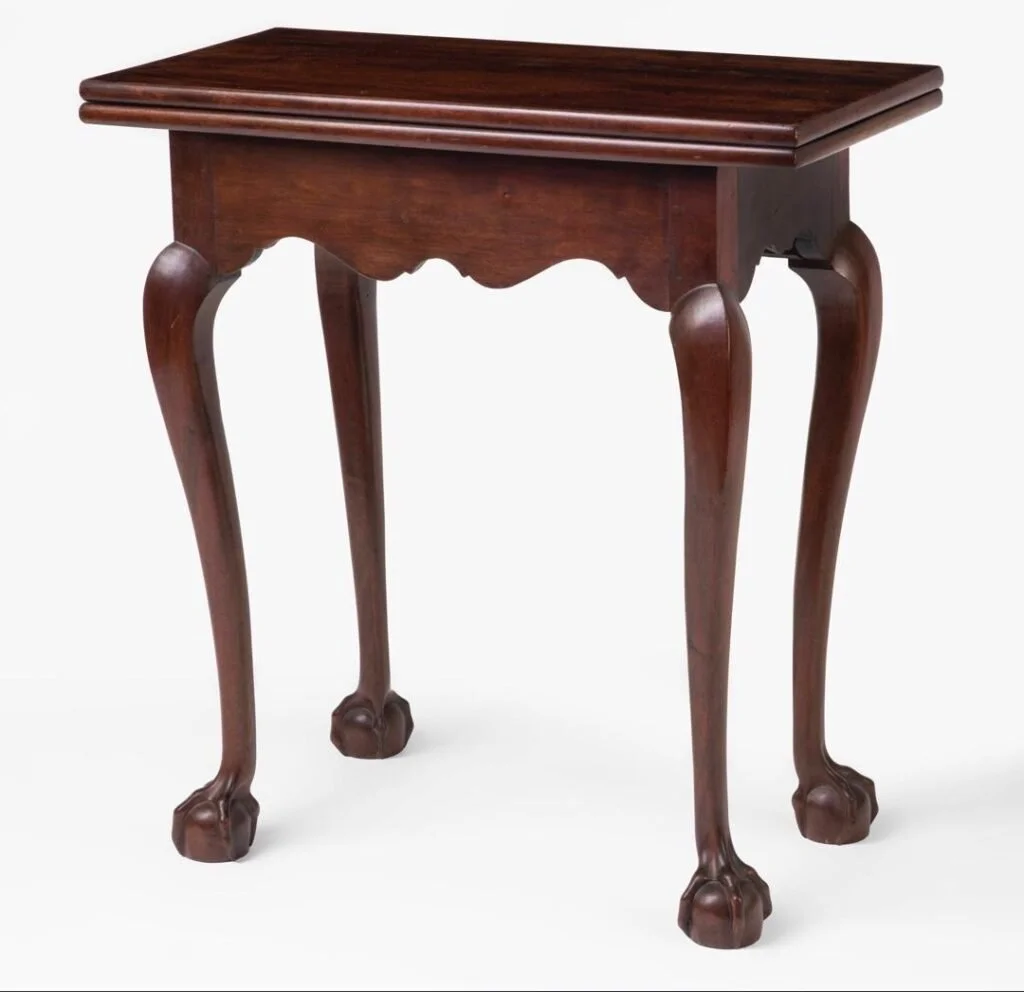
Probably Essex County, Massachusetts, circa 1760–1785
Mahogany with white pine secondary; original brass hinges. Old repair to crack in front leg; polished surface.
Height 28 inches; top: 28 ½ x 13 inches; base: 20 ½ x 11 ½ inches.
Of notably small and desirable scale, this Chippendale card table features a boldly overhanging rectangular top above cyma-scalloped aprons and cabriole legs terminating in finely carved claw-and-ball feet. The sharply defined, pointed knees are characteristic of furniture attributed to Essex County, Massachusetts.
Provenance:
Probably with Jess Pavey, Birmingham, Michigan;
Private collection
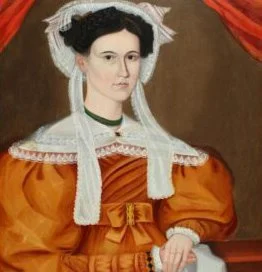
Origin: Probably New England
Circa: 1830 Materials & Dimensions: Oil on canvas. 34 × 28 inches
Description:
This striking portrait depicts a young woman in a vivid orange dress, accented by a lace bonnet and collar and a distinctive green choker. Her direct gaze and poised presence give the work an immediacy and refinement rarely encountered in naïve portraiture.
The painting takes its name from its discovery at the Ainsworth house in Medina, Ohio. Though the artist remains unidentified, works of this calibre—combining bold colour, compositional confidence, and strong personality—are exceptionally rare within the tradition.
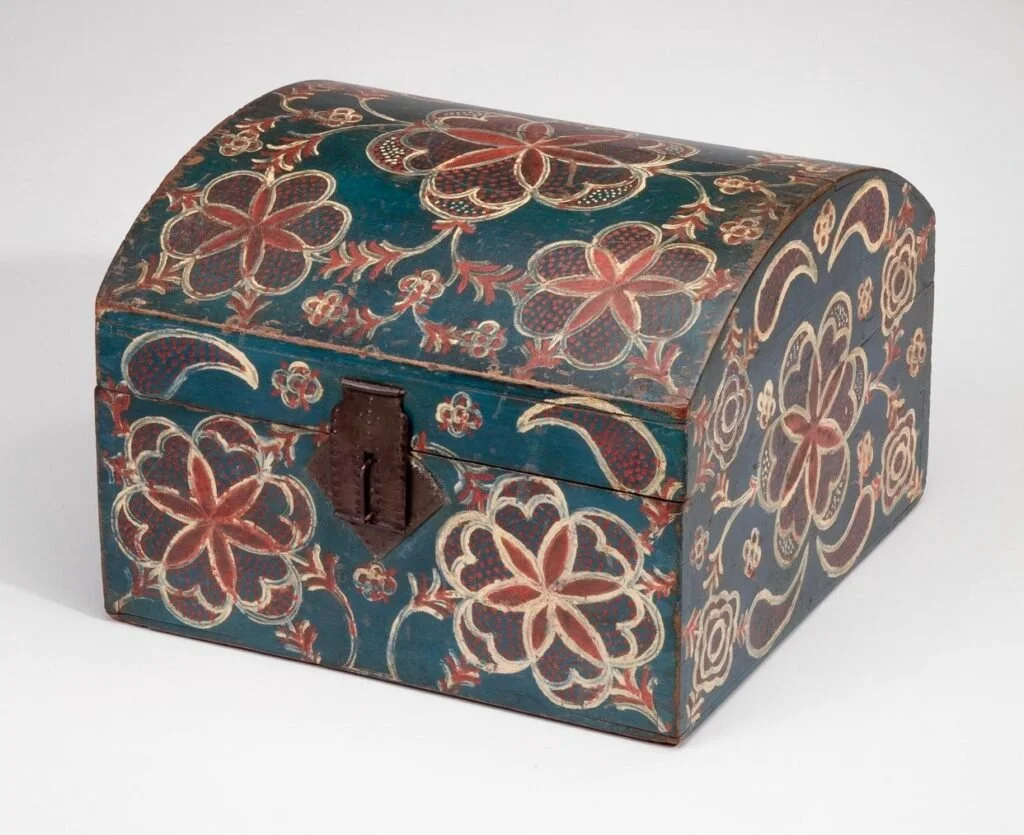
Lancaster County, Pennsylvania, circa 1800–1840
Poplar with original painted decoration; tinned iron hasp and hinges.
8 ¼ x 11 x 11 inches
This dome-top box is attributed to the anonymous artisan known as the “Compass Decorator,” named for the precise, compass-drawn pinwheel and floral motifs that define his work. His output includes a small but distinctive group of boxes and chests, all marked by confident geometry and finely executed painted surfaces.
Provenance:
Distinguished private collection